Thursday, 7 June 2012

Tablas Island Odiongan Agri Fair

Agri Fair Odiongan Fiesta

Once a year during Fiesta in Odiongan, a mammoth effort results in a week long Agricultural Fair.  Our Fair day began in the truck travelling through the Barangay Linawan  to pick up fresh produce and handcrafts.  Farmers were at the roadside with melons, bananas, cassava, bodi beans, even some freshly dug clams and squirming crab.  By the time we were through the Barangay, you could not see out the back of the truck!


We arrive at the Fair but before we enter, we study the ice cream man offering ice cream in a bun or on a cone.  His little bell on his bicycle alerts all ice cream fans of his approach.  Her choice was  ice cream in a bun.


Dario proceeds to throw the coconuts over the fence for the booth set up.  When you consider how far a coconut has to fall from the tree, it is not an insult to throw it over the fence.

The Agro Fair is a great place to learn what is being produced, processed, handcrafted, grown, researched or manufactured in the area.  We set out to adventure.  Dario and agricultural employees are setting up the booth from San Andres.  Displays are beautiful!  It`s early morning and produce is fresh. 

We are looking at agricultural products grown or made in San Andres or on Tablas Island.  To our surprise, there are many.  We are really impressed by the research and assistance provided to develop, produce and label products by the Romblon Provincial Science and Technology Centre. 


Our favorite drink was an almost thawed Buk Juice.  Freshly grated coconut juice with the soft coconut strands in the drink.  How refreshing.  Lydia has to confess to having two!


There was a demonstration of basket weaving, a donut maker making donuts, and all manner of produce, salt fish, dried fish, live hens, duck eggs, ostrich eggs for the equilivant of $12 Canadian each.

Dept of Agriculture was displaying the equipment needed to make Briquettes.  This excellent project uses rice hulls, coconut shells and husks, mill waste: otherwise wasted materials to make Briquettes.


What a great way to learn about all aspects of Agriculture on Tablas!

Allan and Lydia Sorflaten


Tablas Island: The Cajil Caves

The Cajil Caves

One of the undiscovered treasures on Tablas Island is its many hidden limestone caves. Cajil Cave is really several interconnected natural caves located in Barangay Pag-Alad.   During the World War II Roman Catholic Masses were held within the large cathedral-like cave. 
We arm ourselves with flashlights and head lamps and wear secure footware (sneakers, not sandals). Dario goes to look for one or two boys from the Pag-Alad who know the Cajil Caves well enough to guide us!  He arrives with a dozen eager fellows, all wanting to take us into the caves. 
 We travel through a couple of people's yards noting that you would really have to know where to go as there is no marked path through the rainforest!   When we look at the passageway, we wonder if we will be able to fit! 

We are soon able to stand fully upright and investigate the formations using our flashlights and headlamps.  It is so dark.  So secluded.  No wonder it was used as a hiding place for the village people during World War II.


Using our flashlights to break the total darkness, we discover sparkling crystalline formations, hidden caverns, beautiful formations.


In one deep cavern, there were bats hanging.  We unknowingly caught this one on film flying!

 At one point we look way up to see daylight making its way through an opening.


We exit in a different spot than we entered.  Our guides lead us  back to the road.  With further development  this could be an entrance to the caves.

The Cajil Caves are unlabeled and  somewhat hidden but local guides are anxious to show this wonder of nature to interested adventurers.


Tuesday, 5 June 2012

Marketing Workshops

Thirty five participants were chosen from San Andres. The schedule was set to work around Fiesta, Easter and the Agricultural Fair. A letter of invitation was printed and  a member of the Ministry of Agriculture took announcements around to the selected persons on a motorcycle. 
 April 4 - Introduction         - Marketing Strategies & Planning                                                                                                                                                      -               Produce & Agro Product in San Andres
April 10 - New Product Innovation
Agro Processing in 3 Developing Countries                                                  
(Cameroon, Africa, Guyana, Caribbean)
April 11 Marketing Strategies :The 5 P's of Marketing
April 13 Branding, Logo, Packaging, Promotion
April 16  Food Safety
April 18  Labeling, Gift Tags, Display Planning
April 23  Assembly of Displays, Wrap-Up.
Using a collection of photos taken on during our introduction to San Andres, we examined local products available at the Airport and Local Markets!  Some participants were fluent in English while others neeeded translation assistance provided by Agricultural department personal who were present.


Participants grouped according to their business:
Fish Processor
Brooms Makers
Furniture Making, Mats, Hand Woven Purses
Baked Goods, Peanut Butter Manufacturer and Condiments
Food Vending, Snack Foods, Restaurant, Water Bottling

Groups were given activities. Participants were eager to present group findings.  Here Ronnie presents his group's evaluation on product packaging. 


Over the six full day seminars, momentum grew. 
Personalities quickly began to emerge.  The Tiger Grass Broom Makers quickly formed a group they called ROTA (Ronnie, Ontoy, Tony and Alvin).  When it came time to design their logo, they artistically drew the extinct bird that is the symbol for San Andres.  They superimposed this on the flag of the Philippines.  Most unique.  Off to a good start!


When the observation was made that their brooms could not fit  into a suitcase for travel,  their imagination set to work. That it how the Tiger Grass Broom family was born!  From the drawing board to the shop, the first baby tiger grass broom was made.  This broom is firm and will have jobs that are different from the larger, softer tiger grass brooms.   Onward and beyond, next came Mama broom and Papa broom ready to fit in a suitcase.  The full story will be available in a future blog and is now a movie:

The Fish Processors surprised us in another way.  They began to realize that instead of giving their fish away, they could package, label it and sell it for a price.


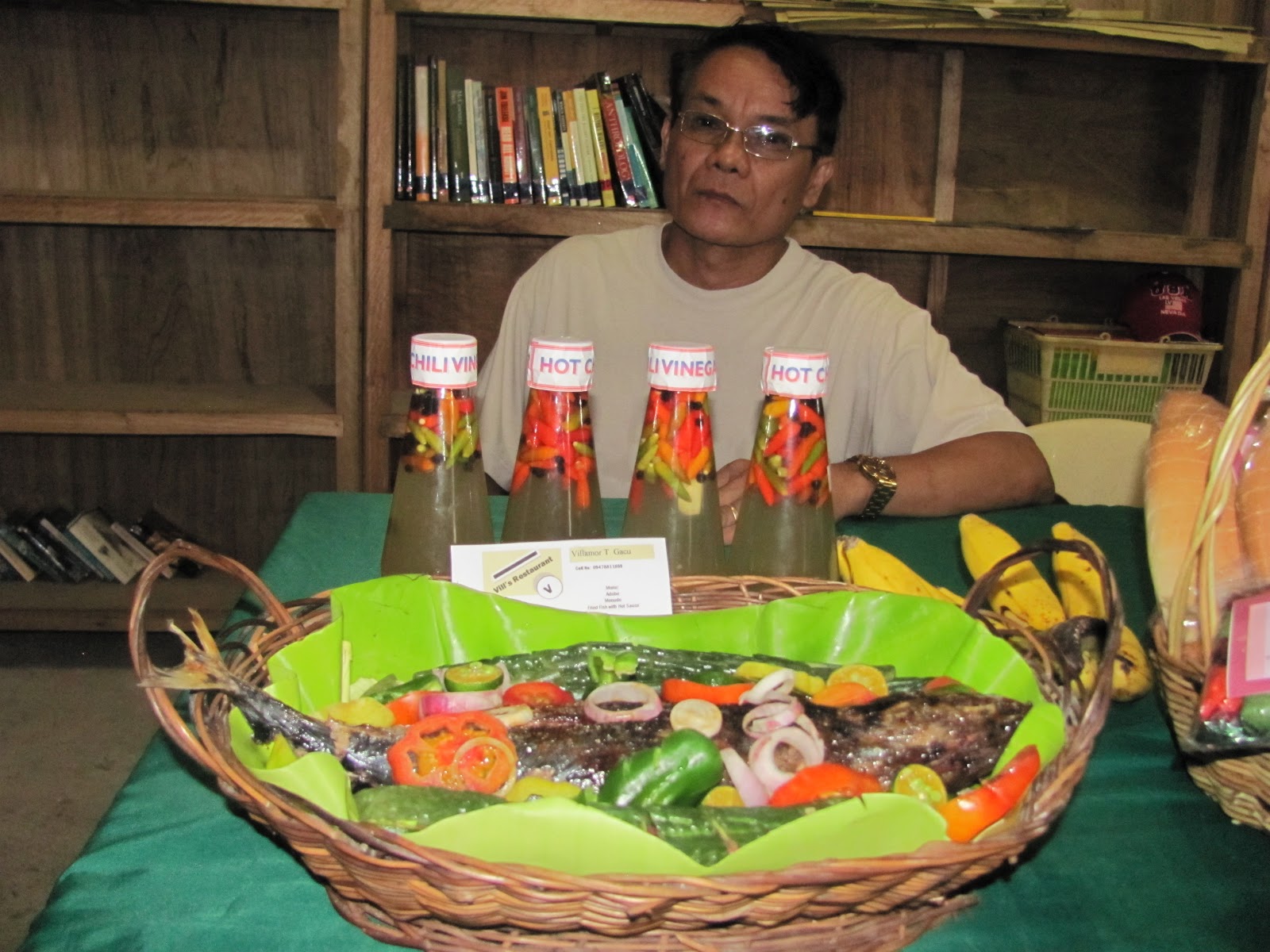
Vills who operates a restaurant arrived with his locally famous marinated stuffed fish.  Here is Vills with his  hot chili coconut vinegar and marinated fish:

Whether it be Tamarind, Squash or Coconut Candies, Atchara, Bakery Goods or Peanut Butter,  participants proudly display their new labels developed in the workshops.


<><><><><><><><><><><>
<><><><><><><><><><><>
  Spices tend to define a country's culinary uniqueness.  In the market in San Andres, 
the spices were unidentified, not labelled. This presented a great subject for discussion for the labelling workshop. It was great to have a ‘spice lady’ as part of the workshop.
Outstanding weavers make hats, baskets, purses and bags.  Hang tags, posters, and labels were developed for handcrafters participating in the workshop.

.

Below, a furniture maker who took part of our seminar, stands by shelving made by her company.

Lilia of Almohed's Hollow Blocks hold the banner designed to advertize her concrete block business.

Great diversity.  Lots of good laughs.  Great help from the staff of the Municipal Agricultural Dept. 


Thursday, 31 May 2012

Tablas Island Coconut Harvest

Coconut Harvest on Tablas Island

Coconut harvesting happens every three months.  We live in a coconut grove with coconut palms stretching an estimated 60 feet in height.  The first picture will show the grove looking toward Sunset Beach, the second a newly thinned coconut stand.  Thinning coconut palms allows the sun in resulting in  a better crop.


 We could hear big coconuts hitting the ground at a rapid rate.  With a little investigation, we discover someone 60 feet up the tree dropping coconuts to the ground using a big knife.  Here he is, small but mighty, ready to climb another coconut tree!   Next the bullock is hitched to the family crafted cart for transport to the coco bin.   He will pick up the coconuts that are newly cut from the tree as well as nuts on the ground.  This way they can be processed simultaneously. 


First the husk has to be removed.  A  special three legged sturdy tree is found in the forest to form the stand for the iron spear.  The spear is mounted to drive each coconut down on to split the coconut husk into four parts, peeling off each quarter, leaving the husk intact to toss over to the pile ready to build the smoldering fire to dry the coconut meat in the coconut bin.

This is a family business. .  Mother skillfully cuts the coconut in two with her cutless and quickly removes the loose fibres so they won’t catch fire while drying.   Children enjoy coming to the coco bin to help throw the split coconuts into the bin where they will dry.   In the picture to the right the mother stops to remove the edible seed inside the coconut so we can eat the seed.  The seed is the size of an egg and delicious to eat.


The coco bin is prepared with the coconuts on top to be dried and the husks below to light and smolder to dry the coconuts.
Again, we were very fortunate to be able to witness first hand coconut harvest at our doorstep!

Allan and Lydia Sorflaten