Monday, 28 January 2013

Orphans and Vulnerable Children, Microcredit Women (Promoters)


Orphans and Vulnerable Children, Microcredit Women (Promoters)

IDF’s web site (http://idfbamenda.wordpress.com/ourwork/) has a wealth of history of its involvement in  building programs in Wum area to help Orphans and Vulnerable Children (OVC) and women with living with HIV AIDS.   The web site has great detail.  These two sections are particularly relevant to our visits in Wum.


IDF has been active for over a decade working towards improving the quality of life of those living with HIV/AIDS, reducing the stigma associated with the disease, and sensitizing the population about positive living and preventative measures. IDF was among the first organizations in Cameroon to develop a program focused on providing home-based care to people living with HIV and AIDS through home visits and using community volunteers. Through its community health programs, IDF has supported more than 1500 orphans and vulnerable children (OVC)  at various education levels; provided support and training to infected women through a partnership with savings and loans cooperatives and the International Labor Organization; and provided HIV and AIDS education campaigns in over 36 communities, 89 villages and 60 secondary schools.

Women empowerment


After becoming aware than many young girls wanted to become house girls and secretaries but did not have the means to obtain formal training in these areas, IDF developed a vocational training program for single adolescent mothers. IDF has trained 47 women to date providing them with skills for healthy living along with vocation training. IDF has also worked in the area of women’s empowerment through capacity building of saving and loans cooperatives and providing women living with HIV/AIDS with business knowledge in partnership with the International Labor Organization.

So, November 2011 we visited several orphans who are now apprentices and a number of women who have small businesses through the microcredit program set up by IDF.  It was very rewarding to be able to visit each of these individuals again to see how their lives had changed.  Each was invited to come to the IDF office later that day to pick up a package, gift of the Sorflatens!  How better to share our Christmas than to give where the need is greatest.  Each package contained three large bars of soap, a package containing several small boxed of matches, a roll of toilet paper (luxury!), and a bag of rice (another luxury).  It was amazing to see how appreciative of this parcel each was but that is getting ahead of my story!

Early morning, we could hear Henry and staff preparing the packages. 

The Store Keeper.  Last year our visit found her doing well and operating her store successfully.  Last year’s visit:

 http://www.youtube.com/watch?v=pTAeWA2fuwc

This year we were shocked to find her recovering from a long illness.  She said ‘black lung’.  She did go to the doctor and had one round of pills.  People living with HIV AIDS must take their antiretroviral drugs daily and eat well, otherwise they get very sick very quickly.   Her store was empty, her spirit low but she is determined to restock her store.


  She came later for her parcel with her daughter.  It is good to see her smiling!


Evodia:  Farmer, Jewelery Maker, Village Guide

Last year, when we visited Evodia, she was so proud of her pigs.

http://www.youtube.com/watch?v=PR1MH8Qf_xw

Unfortunately, her pigs died of African Swine Flu.  Mother Oussematou, as Evodia calls her, has been Evodia’s guardian angel.  Evodia got very sick when her pigs died and had to go to hospital.  Evodia has been doing some farming but recently her crops were run over by free wandering livestock.  Life is sure rough!  But, Evodia was an excellent guide for our day of walking visits around the market and village in Wum. Here we are going up the hill to Evodia's village.

Walking to the Village (Wum)
 
 
African Swine Flu Killed The Pigs
Evodia hopes before long that she will be able to again have pigs.
 
Olga:  Pig Farmer
We had a delightful visit with Olga, another pig farmer in the village.  Her story is a little different.  Not all of her pigs died with the African Swine Flu.  Olga ingeniously makes a soup for her pigs each day by collecting fish water she calls it from the local fish seller, mixing it with banana skins, vegetable peelings, soya beans to make a very nutritious soup. 
 
 
Visit Olga on utube.  What a delightful person living a full and healthy life now.
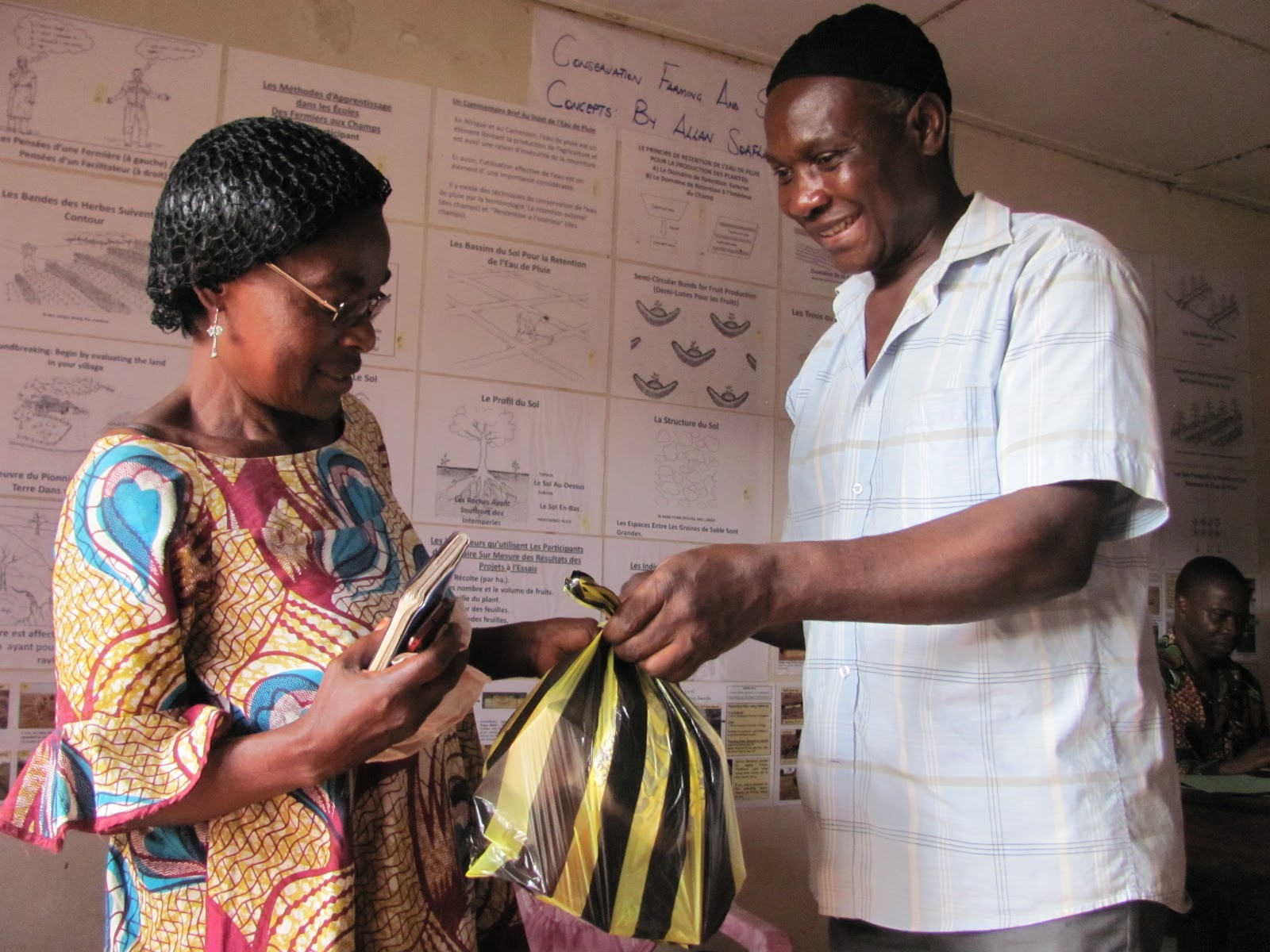
 
 
Olga receiving her package from Amhad, an IDF worker in Wum


Visiting Microcredit Promoters at the Market in Wum
Storekeeper at the Market in Wum
 
This store keeper has a great sense of humour!
Visiting Apprentices in Training in Wum:
(OVC)  Orphans and Vunerable Children)

One sad part of this story is that the government set this program up five years ago.  The government abandoned the program but IDF continues to visit each orphan and do what it can for them.

Mechanic Apprentice:


He has been in the apprenticeship program training to be a mechanic for five years.
Hairdresser Apprentices:

 
Seamstress Apprentice:
She has been an apprentice for five years and is taking night school


Store Front Seamstress Apprentice


Henry recording the visit for IDF records.

Visit the Apprentice Seamstress at her shop:

http://www.youtube.com/watch?v=waUKRgRDPEA


Harry, the shoemaker, receiving his Nutrition Manual at the IDF Office in Wum
 
An opportunity arose to give money to purchase orthopedic shoes for this child.

 
What a fulfilling day in Wum!
 
The Sorflatens'


Friday, 25 January 2013

Wum: Farm Field School in Conservation Farming Field Day in Befang


The Morning Star Hotel, Wum
Rated one star, maybe.  We knew enough from our experience at the Morning Star last year to buy a foam to put under what was a foam mattress in its younger years.  (Allan said last year, don’t ask me to move, I have these slats lined up with my bones!)  We brought our electric kettle and took it to the desk in the am.  The entrance immediately blew!  The hotel person agreed to heat the water in the kitchen.  Although they were able to restore the electricity right away, the main source of electricity for the village of Wum failed to give us power for most of the three days we were there.  That meant no water.  Oh well, the pail works for flushing the waterless toilet (dry tank at the best of times!)  We are both looking forward to the luxury of a toilet seat!  We knew there was no meal service and ate well from our food box.  The bread molded over night but we had crackers, soya milk, juice and our ever reliable canned  tuna fish.   So, after a good night’s sleep, we were eager to move forward with our three activity filled days.
On our way to the Green Valley Farm in Befang, Menchum Valley, we stopped at the school to deliver the sign but it wasn't as easy as that. First we had to figure out how to transport the sign. We decided that buying a foam to put on top of the car was the right way to go. 
 
When we arrived at the school, no words were needed when Lydia met the Head Mistress. 


Farm Field School in Conservation Farming/Nutrition/Field Day in Befang.
Arriving at Joseph Tafrie's home, we found he had built an awning out from his platform to protect Farm Field School participants from the hot sun.  Farmers had already begun gathering. 
 
 
Mr. Tafrie opened the workshop by saying that they were there to learn new ways.
 
Terance, one of the IDF staff,  introduced the workshop using the home made for us bamboo rack to hang the flip chart guidelines from.
 
  Allan used his series of large diagrams to show the basic concepts. Oussematou translated from English to their native dialect.   
Discussion was animated. One topic that was widely discussed was contour farming.  Through the discussion that arose from Allan saying ' I don't see rows going across the hill, rather, going down the hill.'  Tafrie asked farmers 'Why do you do it this way?'  The answer seemed to be that when the heavy rains come, they wash the soil to the bottom not disturbing the row!
Conservation farming offers ideas to conserve soil, well explained by Allan using his diagrams to graphically illustrate concepts new to these farmers.  Mr Tafrie said that crucial to the area is that the  land on the flat (Mecham Valley floor)  is all taken up.  Hillside farming would expand available farm land.  So, contor farming is important to the development of this critical resource.
Last year, we walked into the Mechum Valley Rice Farming area.  This video shows the valley floor well used as Mr Tafrie guides us on the tour:
Menchum Green Valley Rice Growers Cooperative Farm Tour
 
Practical Field Plot:
From here we moved to the practical field demonstration.   A test plot had been designated for the Farm Field School to use.  Participants quickly went about slashing brush with their cutlasses and piling it for use as mulch, leaving the soil undisturbed (zero tillage).  (The usual practice would have been to thoroughly dig up the soil and make rows.)   Farmers are interested to see how much easier this would be.  Allan produced his twine to measure out planting distance.   He asked the participants to  mark the twine using bottle caps clamped on the twine at 1 meter intervals.  That all sounds simple until you introduce a tape measure and attempt to find one meter! 
Lining up the rows with twine marked with bottle caps one meter apart.
 
Marking for digging holes.
Preparing cassava for planting right side up!

Girls, that looks like a big hole!  They are ready to add manure-see the scoop?

A wheelbarrow of goat manure is so valuable!

Mixing goat manure with soil.
 
Planting the cassava cutting upright, right side up.
 
 
Watering because it is the beginning of dry season.
 

One row of cassava is planted horizontal (the traditional way)
The second row, the cassava cuttings are planted upright (a new way)
 
 
Soil Testing. 
The group decided where soil of different types could be found.  The soil in this area is very fertile and they were challenged to determine where to find sandy soil.  The three samples were mixed with water and allowed to sit on a stump to settle for one hour. 
Waiting for soil samples to settle.
This workshop was different in a number of ways.  After the introduction to Conservation Farming Workshop last year, farmers led by Mr. Tafrie, have begun a large test plot to grow hot peppers.  We proceeded to the hillside plot where the hot pepper project is underway.  The hillside is quite steep.  They cleared the land, zero tillage.  The Sorflatens donated a water hose, a barrel and watering cans.  This project is aiming for a good market time for hot peppers because it is out of season (dry season) so the plants will have to be watered.

The hill is steeper than it looks.
 
Contouring walls will be built using rocks.
 
Small Hot Pepper Plant Grown in Nursery Planted on Hillside
Have a look at the utube to see the workshop in action!
Befang Green Valley Farmers, Cameroon, Africa through Farm Field School Training in Conservation Farming plant Hot Peppers splitting the hillside to see if new ideas of coutour farming will retain soil better and produce a good crop.  Canadian Executive Service Organization volunteer advisor Allan Sorflaten conducts the Farm Field School, Joseph Tafrie leads the farm group in the hot pepper project.  Integrated Development Foundation under the direction of Mme. Oussematou coordinates the workshop to assist farmers to learn new methods.


Wednesday, 23 January 2013

Wum: Good Luck Getting There

Wum:  Good Luck Getting There

The Bus Station
The bus station is an experience in itself.  This is a picture of the bus station.  Buses are vans. 


Now, to get the sign to Wum.  We all went to the bus station.  Oussematou then hired a van to go to the sign makers shop to pick up the sign.  Again, she bought cardboard and lots of tape. 
 Scribblers and pens and pencils, teachers record book and boxes of white and colored chalk  and other gifts were soon to be on their way to Wum, in a seat paid for in the van!  We could not all fit in the car so Terrance of IDF went in the Van with the sign for the trip to Wum.   Now for our journey.  Little did we know! We did know that a major bridge had been washed out a year ago and two people were killed. 
Working on a New Bridge!
 
 
Present Bridge
 
 Everyone said the road was terrible but to experience it is something else.  This road is beyond a road grader.  It needs to be rebuilt.  It seems that decisions are made in the far away capital and remote regions are not priority.  This road is impassable when it rains and almost impassable when it is dry.    We dipped and climbed through the ruts and carefully eased our way over the exposed ledges.
 
When things like this happen, passengers just sit along the side of the road hoping someone will come to help.
 
 About half way to Wum, a truck overtook us, signalling for us to pull over.  ‘Did we know that we were leaking a stream of fuel behind us?’ 
 
 
  The driver jacked the car up to look at the damaged fuel line.
 
  He and Allan decided that the best thing to do was to travel as fast as we could as far as we could.  There is no help along this road.  I really don’t know what one would do if one encountered a breakdown but we saw several vans stopped with the people sitting waiting for help. 

Anyhow, about our dilemma.  Since the car was diesel, we felt there was not a danger of fire.  So, we headed out to again navigate the ruts, ridges, washouts and galleys.  
 We were very relieved to arrive in Wum.  Because of our fuel problem, we had to drive past the school without stopping!  Our driver dropped us at the Morning Star (I refuse to call it a Hotel) and went immediately to get the fuel line fixed (Sunday). 


GS Illum School Rebuilding Project: Preparing


G. S. Illum School Rebuilding Project: Preparing

The Rotary Club of Truro, working through Hand Up, embarked on a project to rebuild the two room school near Wum, North West Cameroon.  Money was moved through the Rotary Club of Bafoussam.

As CESO volunteers on assignment in Bamenda, Rotarian Lydia and husband Allan were privileged to be able to watch the Integrated Development Foundation (IDF) carry this project through to a successful end, meeting many challenges along the way.  The Chairperson of the IDF board, Joseph Tafrie, was community leader.  He lives relatively near in Befang.  The road from Befang to the school, like the road to Wum from Bamenda has many very rough places, one of which was a near wash out almost taking the road with it down the steep cliff.  Mr. Tafrie has a motorbike that has allowed  him to travel to the community and school site.  Many challenges were faced.  Initially, two walls of the school had to be addressed as they had deteriorated (note the mortar work).  You will be able to see from the pictures that Mr. Tafrie took using a camera donated by Marian Ward from Nova Scotia, the work as it progressed.  Windows and doors were constructed by the carpenter.  An overhang to protect the platform was extended from the roof.  Rocks were collected to build a base for the platform.  Mr. Tafrie stored the cement at his home, supervising each mixing so the mix would be right.  He brought water in a tank on the back of his bike to the school for the mixing.  He asked the Parent Teacher Group to send parents to help carry the water from his bike to the mixing area.  No one came so children carried water to the mixing area.  Cement was mixed for the platform and for each classroom floor. 

A word about zigger worm.  Children had been going to school and spending the day with a dirt floor.  Zigger worm is very painful.  Parents remove zigger worm from the children’s feet using a safety pin.  This exposes the child to possible tetanus and infection.  Now, the new concrete floors well cleaned and swept will help prevent this problem.

The work actually began the second week of our assignment, after the money was transferred to IDF.   Mr. Tafrie came to Bamenda to plan with Mme. Oussematou the first Monday we were there.  We gave him the camera Marian had donated to take pictures of the various stages of construction.  It is really interesting to see a person use a camera for the first time.  The pictures he took are excellent.  The camera stays around his neck, ready.  We bought a battery charger and rechargeable batteries for the camera.  He has electricity in his home.

That brings us to another topic.  Lydia assumed from our visit there last year that because there were fluorescent lights in the adjacent school that there was electricity.  Nope.  Electricity has not made it to the GS Illum site as yet!

Lumber and roofing materials were brought from Wum (about 15 miles from the school) by a motorbike that has a carrying cart attached. 

The children who attend GS Illum’s two room school were given Thursday and Friday off so construction could proceed.  The aim was to finish the Rotary rebuild project for hand over before we left. 

Meanwhile, back in Bamenda, Oussematou had been working hard to have the furniture built.  This part of the project was Rotary Club of Truro (1000 and District Simplified Funds 1000 Canadian Dollars).  This money would also buy each child a large (legal sized) notebook, a pencil, a pencil case, a bonbon and a bag to put it in.  IDF knows how to go about things.  This parcel must be placed directly into each child’s hands in order to assure that the child will receive the package. 

So, on the Friday before we left for our three day stay in Wum, we spent the morning at the furniture making cooperative.  When you see the quality of workmanship, you will be amazed.  As they said at the handover ceremony, no other school has such beautifully made furniture!  The wood is a very hard wood.  There are three large double door locked storage cupboards, three teachers chairs with upholstered chair seats and chair backs and three teacher’s desks.  The desk for the Headmistress has a locked drawer and the legs are turned on a lathe.  All are well finished with nice hardware pulls.  We were impressed with the coop and its caring for members who have HIV AIDS.  This was a big job and well done.


This link will take you to a video on site where the furniture was built in Bamenda.
 
So our small part.  Oussematou hired transport.  The van would not pass inspection in Nova Scotia!  When we arrived in the yard of the furniture making coop, the transport van had arrived and they had the first double door cupboard placed on top of the van.  Oussematou immediately left to buy cardboard and foam pieces to act as separators to prevent scratches.  Allan watched, wishing for some duck tape and more rope.  They used recycled tires cut in strips to tie down the load.  As the load increased in height, we became increasingly concerned about the journey and at that point we did not know how badly the road to Wum had deteriorated!  At first we thought that they would put the desks in the van.  Nope.  On top to allow as many passengers to travel as possible! So, three double cupboards, three desks and three chairs three hours later were loaded on top, strapped down, hopefully sufficiently separated and packed to make the journey.  We held our breath as the van climbed up to the street from the coop yard.  The builder went with his furniture.  The journey took almost six hours hours.  They called Oussematou when they arrived at the school.  Oussematou called the Head Mistress to go to the school to let them in. 

There was not enough money in the Rotary budget to pay for the building of a sign so the Sorflaten’s said, go ahead and they would pay.  Fortunately, Lydia had a Rotary Club of Truro banner from which they were able to work from for the design.  We took the Rotary International logo from a Hand Up newsletter Lydia had on her computer.  Oussematou took the design to the sign makers.  The sign maker operates from a small room.  They have several apprentices on site learning the trade.  They make amazing screen print shirts as well as signs.  All lettering is hand cut using an exacta knife.  Sign making and sign painting is done outside. 

The following link will take you to a utube filmed at the sign makers:
http://www.youtube.com/watch?v=8BJSZxOQNZA&list=UUKLdLUrOXVJPkIJuTTJxaAQ&index=3

When you watch the videos, you will see how the Rotary project helped a cooperative who builds quality furniture and cares for HIV AIDS affected members of the cooperative.  We were most impressed at the sign makers to see young people given an opportunity to learn a skill as an apprentice.

This link takes you to a full slide show of the Rotary Club of Truro Rebuild and Equipping of the GS Illum School near Wum, Bamenda, Cameroon, Africa

http://www.slideshare.net/LydiaSorflaten/gs-illum-school-project-presentation


Tuesday, 22 January 2013

Nutrition Workshops


Nutrition Workshops:

The two day workshop in Bana was done in French.  A Nutrition Manuel was prepared in French, printed and ring bound for participants.  The Pyramid Model was used to classify foods, Energy Foods, Protective and Body Building Foods.  As basic as it may seem, participants were learning for the first time about basic food groups and their classification.  Oussematou laughed at Lydia’s clever ways to avoid having to speak a lot of French!  Lydia made a slide show of over 100 local foods.  A small picture of each food was placed on the pyramid when the group decided which food group it belonged to. Participants quickly learned to classify foods, putting palm oil, salt and biscuits as extras. 


 A number of very interesting learnings emerged.  The main diet consists of fufu (yellow corn pounded, mixed with water and steamed in banana leaf).  Fufu is dipped in a mixture of salt and palm oil (high in saturated fat).  Participants quickly decided that it was possible to balance meals by adding beans or ground nuts and a vegetable and or a fruit  to each meal.   In Bana, participants noted a disappearance of two important protein sources, ie lowered production of ground nuts (peanuts) and cow peas (looks like a white bean grown in a red peanut-like shell).  Both ground nuts and cow peas are excellent sources of complete protein.    One resolution by the participants at the end of the workshops in Bana was to encourage the reintroduction of ground nuts and cow peas. 
An action plan to use cassava leaf was made when it was discovered that this potentially abundant source of Vitamins A and C was not being used.  Oussematou worked with the cook at the Calipso Hotel to make a delicious dish using cassava leaves, squash, leeks and shrimp.  Since the participants had never had cassava leaf cooked before, they were very surprised to find it so delicious.  Huckleberry leaf is most often served as a vegetable but it is very expensive and difficult to get in dry season.  Mixed with dried fish it is like our dandelion greens, a great laxative! 

Only babies have milk.  Milk is unknown here.  We enjoy soya milk sold in different flavors but it is too expensive for the average person to buy here.  One thing Oussematou is going to do is contact a person who makes soya drink in her home and find out how.  Also, it was resolved to encourage increased use of soya beans in preparing local dishes (great source of calcium and complete protein).

Three nutritional related problems in the North West of Cameroon were targeted in the Nutrition Workshops:  Diabetes (they call it ‘getting sugar’), Hypertension and Nutrition Problems related to HIV AIDS.  In Bana, the Administrator of the Hospital who is not only a nurse but an excellent teacher addressed each diagram and explanation that we thankfully were able to project on the screen.  He elaborated on each problem.  The participants really appreciated learning for the first time the reasons behind each problem, factors that cannot be controlled, how the body is affected and how diet can be altered to help.  Lydia had been able, by taking pictures from slide shows from the internet, to make excellent power point presentations on each of the three major nutrition related problems in this country and translate the commentary into French via Google translator.
 

We were fortunate but had one unfortunate incident in Bana in relation to power outages.  IDF is always prepared for no power.  In fact, they plan on no power by using flip charts well prepared for animation.  Well, we had been able to use all the excellent power point programs that we had prepared as well as the utubes on Conservation Farming and excellent utube case studies of patient visit to homes in other parts of Africa were HIV AIDS.  But at one point, there was a power outage.  Hospital personal started up their generator.  IDF’s voltage regulator (we had bought and brought an identical voltage regulator for $70 Canadian) blew!  We know enough not to have our computers hooked up in such situations and have several batteries for each computer that we charge up when we are able to patch us through when the outages occur.  As I write this in Wum, we have been without power since 2pm yesterday and it is now 10 am so that is heading to a full day.  The day before in Wum was another stretch.  At 8 o’clock we went to bed as there was no power and Lydia did not to use the valuable computer battery power.  We awoke for the power to come on at 3am.  We had forgotten to turn off the single pigtail light hanging from the ceiling!

Role play of patient visits proved extremely effective.  These people are born actors!  The first patient-community volunteer portrayed a very serious confidentiality disclosure, the person being HIV positive.  The analysis of the reaction of the community volunteer was harsh.  This person was telling the community volunteer something very serious in confidence.  The community volunteer did not show compassion and did not make the person feel comfortable.  The second role play was equally effectively.  Although the community volunteer showed some compassion initially, a patient check list intended as a guide was used as a question by question cold fact response tool.  By the time the group lead by the hospital administrator/nurse and Oussematou, the participants had a much clearer view of how to approach a home visit.  Clearly compassion, confidentially, trust, understanding, security are upmost in visitation.  Red flags situations that require recommendation to go to the medical clinic for immediate assessment and care were discussed.  Really, in the time we had, training could just be introduced. 

The last hour of each day in Bana was devoted to making Sea Heart for Hope chains and earrings.  Everyone participated and was delighted with the results which they were able to keep. 

A second Nutrition Workshop was held in Bamenda at IDF and a small one along with the Farm Field School in Befang.  Three participants travelled from Wum and five from Kumbo to Bamenda for that workshop.  To travel, each of these participants spent six plus hours riding on bad roads to attend.  Having travelled the road from Bamenda to Wum on Sunday, we were appalled by the deterioration of the road.  In fact, it should not be called a road.  It is beyond a road grader.  It needs total rebuilding.  We were very fortunate.  A large truck came up behind us and indicated for us to pull over.  They pointed out to us that we were trailing a stream of fuel.  Our driver had a look at it and he and Allan decided to do our best to go as fast as possible to Wum hoping every kilometer not to breakdown.  Fortunately, the car is a diesel so we were not in danger of fire.  The road is all but impassable by car.  Each area has to be approached so carefully.  If it were to rain, vehicles have to be pushed through deep water and heavy mud ruts.  The road is impassable to cars when it rains.  Large truck break up the road and heavy rains wash areas of the road away as well as bringing down debris from the steep cliffs.  They say government will not consider this a priority until the road is totally impassable.  To us, that is right now.  They say that government decisions are to be made more regionally soon and this will help the decision to address the problem of the roads in North West Cameroon, at the moment and for quite some time, totally neglected!  We were relieved to arrive in Wum and are now back in Bamenda, leaving for Bana tomorrow for wrap up there, then on to Limbe.  What great experiences we are having.  Such richness of culture make all the inconveniences worth it!

Lydia 


Participants were fascinated to discover that one could have an influence on ones weight through diet. 

Farm Field School Field Day Bana


Farm Field School Field Day Bana

http://www.youtube.com/watch?v=LbI3m2xtl_o
Conservation Farming (CF) Farm Field School conducted by Allan Sorflaten PAg, CESO volunteer on site in Bana, Cameroon, Africa as part of a Workshop coordinated by Integrated Development Foundation (IDF) to assist an area where Food Security is in question.    Participants who presently farm depleted soil low in fertility anxiously apply CF principles in planting cassava.  Note the setting up of the plot, the marking of the planting holes, use of the hoe as their means of cultivation, the addition of fowl manure to mix with the soil in the hole, the experimental planting of the cassava upright, the use of mulch between the rows.  Participants water the hole because this is the beginning of dry season for them.

 
Participants arrived at 8 o’clock carrying cutlasses, hoes, watering cans,  cassava cuttings for planting and two very long bamboo poles.  Allan was prepared with lengths of twine and markers in the form of bottle caps.  Work began to clear the plot using cutlasses.  Participants cut small bamboo the length of the distance between the rows.  Bamboo was cut, twine attached the length of a row.  Bottle caps were squeezed together to mark where the cassava plants would be planted.  Rows were set up.  Corners were squared using the long bamboo poles to make a right angled corner.


Mulch from the cuttings was left between the rows.  Ladies marked the row under the twine using the cutlasses.  Holes began being dug with the hoes. Jean Waupi brought chicken manure purchased from Bafoussam.  Participants who were going to handle manure were given breathing masks.  Jean explained that, because dry season is starting, the holes need to be watered before planting.
The cassava farmer explained how to plant the cassava cutting upright (how to choose a proper node, which end is up and how deep to plant it).  Several of the participants commented later that these were things they did not know.

Holes were dug inbetween the cassava and squash seeds were planted.  Holes were watered for the squash as this is the beginning of dry season.  Mulch was lifted, shaken and replaced between the rows. 

 
We moved to the front of the building where participants told what they had learned and we assembled for a group picture.  One of the participants brought a treat- corn she had grown and cooked especially for us.